Sunday, 15 July 2012

30th Anniversary Of The Discovery Of AIDS

During 2011, a number of Commonwealth states issued stamps to commemorate the 30th anniversary of the discovery of the HIV virus which causes AIDS which has been a deadly scourge in many lesser developed Commonwealth countries particularly in Africa. Some of these issues have not been well reported. I have previously mentioned that Cameroun issued a stamp and a miniature sheet on 3 June 2011 but I now discover that the set actually comprised 3 stamps and a miniature sheet. The 500 FCFA value is of particular interest in that it depicts Madame Chantal Biya, wife of President Paul Biya, who was the founder of Synergies Africaines which was set up to lead the campaign against the disease.


In the midst of a multitude of agency-produced stamp issues with little or no relevance in subject matter to Uganda, the country released a set of 6 stamps during 2011 which were clearly meant for use on local mail and have great relevance to the country. I do not yet know the precise date of issue. Four of the stamps are depicted below, the remaining 2 stamps, 1500/- and 1800/-, are similar in design to the illustrated 1900/- and 3400/- values.


Leaving Africa and crossing to Asia, a single stamp was released at the end of 2011 by Sri Lanka. Again, I am not sure of the precise date of issue at the moment.


Saturday, 14 July 2012

Best Olympics Design? Other Interesting South Pacific Items.

On 5 June 2012, Australia issued what I think is the most original and fun London Olympic Games stamp issued so far and not a single sport featured in the design. With iconic London landmarks featured in the background a bold, red London double-decker bus is shown in the foreground. It is not easy to come up with an original approach to an Olympic Games stamp design after the many thousands that have been issued over the years but Australia has come up trumps with this modest little stamp. I think it could well prove to be the best design to commemorate these Games and is available in gummed format from ordinary sheets and self-adhesive from booklets. Three more gummed stamps and 3 self-adhesive stamps will be issued by Australia on 17 July 2012.
Also issued by Australia on 19 June 2012 were two $2 gummed stamps and 1 miniature sheet which commemorate the country's colonial heritage. I particularly like the design on the left which is taken from the 1850 New South Wales "Sydney View" stamp which was based on the design of the Great Seal of the colony and which featured the allegorical figure of Industry greeting convicts or colonists on their arrival to the territory and symbolising the new arrivals' path to redemption and the colony's road to advancement. As mentioned in a recent blog about the bicentenary of Charles Dickens, this particular image recalls the Micawbers who set out for Australia to make their fortune and the convict Magwich whose success there was so great, that he was able to bestow on Pip Pirrip the gift of "Great Expectations", even though it dramatically all ended in tears when he returned unlawfully to England.
The second design depicts the port of Hobart from a design of 1890. With sailing ships in the harbour, a picturesque scene was aimed at promoting Tasmania's natural beauty and influencing potential visitors to the colony.
In a blog a while ago, I drew attention to a personalised stamp design produced by New Zealand Post which appeared to have reference to Vietnamese revolutionary forces, the Viet Cong, whom New Zealand soldiers found themselves fighting during the Vietnam War. I wondered if the individual featured on the stamp was Ho Chi Minh. Apparently, the stamp actually depicted Phan Boi Chau (1867 - 1940) who was a pioneer of 20th century Vietnamese nationalism and who formed a revolutionary organisation, Duy Tan hoi - the "Reformation Society" - in 1903 and whilst living in Japan, wrote political tracts calling for the liberation of Vietnam from the French colonial regime. The French kidnapped him in Shangai in 1925 and he spent the rest of his life kept under house arrest by the French in Hue (comparison with the Burmese leader Ang San Suu Kyi sounds rather appropriate here given her long period of house arrest by the country's military regime).


I found the identification of the individual on the stamp in an article by Glen Stephens in the July 2012 Philatelic Exporter and in the same article he draws attention to another New Zealand Post personalised stamp which was produced in 2009 by them for Bruce Henderson which marked the 50th anniversary of Tibet's struggle for independence from The People's Republic Of China. The stamp depicts the national flag of Tibet but annoyingly was not included in the 2009 personalised stamp collection because of the political nature of the subject of the stamp and indeed New Zealand Post wished the stamps to be returned to them. It seems likely that this was all due to the fear of upsetting the Chinese government.


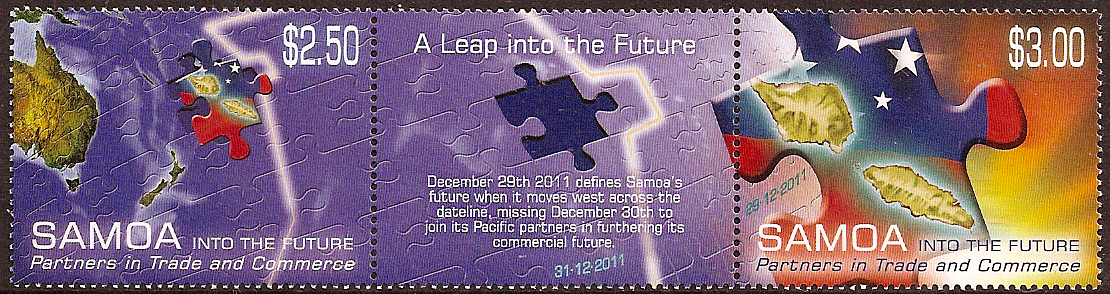
Any logical and reasonable person will fail to understand the difference between the Tibet item and the Phan Boi Chau stamp since they both appear to have highly political subjects and such controversies are typical of what happens when a postal administration finds any excuse for producing stamps to drag money out of stamp collectors in particular, and the mail sending public in general. Remembering the Athens Olympic Games, we recall that the Greek Post Office was forced to withdraw a "Gold Medal Winners" stamp days after it was issued after the commemorated athlete was stripped of his medal for contravening the rules. One only hopes that Royal Mail will not experience a similar problem with its upcoming next day Gold Medal Winners miniature sheets otherwise those who are subscribing to the set which will be sent out after the Games are finished, will find that one or two of the sheets will not be included in the distribution and that they will then be faced with tracking down a rare item at great cost. Have Royal Mail thought about that I wonder? Another recent problem item is the Samoa "Leap into the Future" issue which consists of two stamps produced as a pair with a label between them.
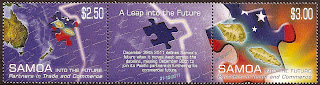

Apparently two versions exist in which one has an error on the label linking the 2 stamps. The correct version includes in the text on the label "missing December 30th to join..." while the error reads "missing December 29th to join...".
"missing December 30th"

"missing December 29th"
A fascinating error, well worth including in one's collection. I managed to track an example after finding advertised on the internet by Sydney Philatelics. I have yet not seen a British dealer offering it.

Monday, 9 July 2012

Canada, Pakistan, Papua New Guinea, Tuvalu and Malta New Issues


The fifth of the Canadian Diamond Jubilee miniature sheets is interesting in its attempt to reproduce the 1897 Queen Victoria Diamond Jubilee stamp by placing side by side as in the 1897 issue, portraits of Queen Elizabeth II which date back to the beginning of her reign and one which is contemporary. The stamp was issued on 7 May 2012 and I find the contemporary portrait to be rather uncomplimentary towards the Queen making her look decidedly chipmunkish although it is nicely printed in intaglio, 


Meanwhile, another pair of monarchs makes an appearance on a Commonwealth stamp, this time the King and Queen of Thailand on a stamp which commemorates the 50th anniversary of their state visit to Pakistan. As Pakistan has issued a stamp featuring a foreign monarch, one wonders if the country's post office may issue a stamp to coincide with the Diamond Jubilee of Queen Elizabeth since she is Head of The Commonwealth, was Queen of Pakistan from 1952 to 1956 and with hundreds of thousands of Pakistanis and their descendants living in Britain, there are clear links between The Queen, Great Britain and Pakistan.


The interesting locally relevant issues of Papua New Guinea continue to appear. On 2 April 2012 an interesting and unusual aspect of the country's culture was depicted on 4 stamps, a sheetlet of 4 stamps and a miniature sheet which all illustrated various local clay pots. I wonder if any of these will ever appear on a PNG version of the Antiques Road Show.


Given that most stamps which appear with Tuvalu's name printed on them have no relevance whatsoever in subject matter to the country, there is no arguing that the theme of an issue of 12 May 2012 is of extreme relevance to Tuvalu. The set of 5 stamps which was issued to coincide with Yeosu World Expo 2012 illustrates 5 different ways to help reduce the damage caused by global warming by which the future existence of Tuvalu as a country is severely threatened. Three of the designs are featured below. Although I rarely obtain Tuvuluan new issues, this is one set which I can justify adding to the pages of my collection.


Finally, Malta Post has released details of its Olympics issue which takes the form of a miniature sheet containing 2 stamps showing the Games' logo and one of the mascots. The item will be issued on 27 July 2012, the day of the opening ceremony.


Sunday, 8 July 2012

Recent Commonwealth WWF Issues

In the next few days three Commonwealth countries will issue sets of stamps which depict wildlife locally endangered in each participating country and bear the World Wide Fund For Nature "panda" emblem. I mentioned the Ghana issue last time for which there is no exact issue date currently reported. The issue which depicts the Bohar Reedbuck also includes a miniature sheet of 2 sets of each value which is a format we frequently see with these issues and I depict it below:-


There is no doubt that these issues are frequently attractive and since they show local creatures and therefore a subject of relevance to the country issuing the stamp I usually like to include them in my Commonwealth collection. It is interesting that this Ghanaian issue is typical of those produced by client countries by the large agency in New York and together with the subjects and types of stamps now being produced by Ghana (as described last time), we can see that agency is once more in the driving seat when it comes to Ghanaian new issues. Typical of the issues produced by New Zealand Post for its client countries is the gorgeous sheetlet of 8 WWF stamps to be issued by Fiji on 11 July 2012. The beautiful Collared Lory is the creature featured on this set.


The stamps are produced as 2 se-tenant strips in the sheetlet as demonstrated below:-


On the same date, 11 July 2012, Kiribati is also due to issue a WWF issue, again in the format of 2 se-tenant strips of 4 stamps in a sheetlet of eight. This issue breaks the recent run of old Kiribati stamps being overprinted and/or surcharged to produce new commemorative stamps as has previously been reported. This issue features the Giant Trevally and is designed by JR Lisiak which is one of the designers that New Zealand Post use when producing stamps for its client territories - he recently designed the lovely Pitcairn Islands' dolphins set and miniature sheet which was issued on 26 April 2012. I have not seen any announcement but I wonder if New Zealand Post has taken over the production of Kiribati's stamps which I would certainly welcome since they produce some of the best new issue stamps around at the moment and it would mean that Kiribati would not fall into the hands of some of the agencies which have been moving in on the Commonwealth Pacific territories and who have been less restrained in number of stamps issued and in the face value of the stamps. New Zealand Post issues are almost always relevant to the countries for whom the stamps are produced and are usually extremely attractive and well designed and printed. 


Finally, some dates of issue are now known:- Aitutaki: Whales definitives, 12 stamps and 1 sheetlet, 22 June 2012, Cook Islands: Olympic Games, 3 stamps  and 1 miniature sheet, 22 June 2012, Tonga: 1st anniversary of democracy, 6 stamps in a sheetlet, 30 May 2012; Centenary of the sinking of RMS Titanic, 4 stamps in a sheetlet and a miniature sheet, 6 June 2012; Olympic Games, 3 stamps and 1 miniature sheet, 25 June 2012 and ANZAC Day, 4 stamps and 1 miniature sheet, 25 June 2012, Tonga Niuafo'ou: Centenary of the sinking of RMS Titanic, 4 stamps in a sheetlet and 1 miniature sheet.

Saturday, 7 July 2012

British Paralympic Winners, Ghana definitives, New Nigeria and Sri Lanka.

 A report in The Daily Telegraph of 7th July 2011 has clarified just what Royal Mail are doing with the Paralympic gold medalists miniature sheet which is designed to show every British gold medal winner at the Games. With approximately 50 gold medal winners likely they are not going to present collectors with a sheet for each winner as they intend to do with the winners at the preceding Olympic Games but to take photographs of groups of Paralympic winners. A merciful release for collectors then who will only have to buy one miniature sheet instead of 40 or 50. A good solution I think. I have recently obtained the new Ghana definitive stamps, which I have previously mentioned, and now illustrate all 10 values below. They were issued on 28 February 2012 and printed in lithography by Enschede.


I previously also mentioned the Ghana 2010 Football World Cup set of 8 stamps and a miniature sheet which depict Ghanaian football players and I have now also obtained those items and depict 2 more values from the set. Also to be released next week are sets of stamps in sheetlets of 4 and miniature sheet format to commemorate the RMS Titanic disaster centenary and the drafting of the proclamation of the emancipation of slaves by Abraham Lincoln, a former president of the United States. There will also be sets on the subjects of "birds of Africa" (4 stamps in a sheetlet and 1 miniature sheet), "parrots of Africa" (6 stamps in a sheetlet and 1 miniature sheet) and the 75th anniversary of the Hindenburg disaster (4 triangular stamps in a sheetlet and 1 miniature sheet). These sets seem to have no relevance or if so, only tangentally, to Ghana and so will not find their way into my collection. There will also be a set of 4 WWF stamps issued in sheetlets of 8 or 16 which depict the Bohor reedbuck.


Also just arrived are some more Nigerian items from 2012. There is a miniature sheet for the Phila Africa philatelic exhibition, previously mentioned, held between the 31 January and 3 February 2012 at Abuja. Rather late, like Ghana, Nigeria has sent out a set of 3 stamps for the 2010 Football World Cup, I do not know when they were issued although the imprint on the stamps says 2009.


There is also a further miniature sheet which appears to have accompanied the set issued on 30 March 2011 on the theme of the province of Benue. Both the Benue and the Phila Africa sheets are imperforate.


Finally, to Sri Lanka. The Sri Lankan Post Office's philatelic website is chaotic but I have gleaned some information from it of the country's issues so far in 2012.  The issues which it mentions and sometimes gives the date of issue of, and occasionally illustrates, are as follows:- Guardstoneat Rathanaprasadeya; 21 March 2012, Legends of Sri Lankan cinema, 6 stamps and a miniature sheet which combines all values; 10 March, Peony stamp; 20 March, Sustainable energy; 1 April, 50th anniversary of the Asia-Pacific Postal Union:-


22 February, Centenary of Scouting in Sri Lanka; 9 February, 25th anniversary of the Institute of Ship Brokers, 1 stamp; 10 April, Sinhala Hindu new year, 4 stamps as depicted below:-


Thursday, 5 July 2012

113. Great Britain and Greece.

  With Greece so much in the news at present, this seems a good time to recall Greece's historic philatelic connections with Great Britain. The Ionian Islands had historically been a dependency of The Venetian Republic until they were seized by the forces of the French tyrant, Bonaparte, in 1797. The Royal Navy  liberated Cephalonia, Santa Maura, Ithace, Cytherea and Zante in 1809, Paxo in 1813 and Corfu in 1814.  By the 1815 Treaty of Paris, Britain was formally given control of the islands  and gave the islands a degree of autonomy but support for union with Greece grew in the islands and they were ceded to Greece on 2 June 1864. Prior to this, stamps were produced for The Ionian Islands and released on 15 June 1859.                


Flag of The Ionian Islands 1815 - 1865
As illustrated above, three values were produced although the stamps were actually undenominated:- 5 obols or one halfpenny (orange stamp),  10 obols or 1 penny (blue) and 20 obols or 2d (carmine). The denominations were omitted to avoid offending the Greek population or the British authorities. The stamps depicted a portrait of Queen Victoria with the surrounding inscription IONIKON KRATOS (Ionian Government) and were engraved by C. Jeens and printed in intaglio by Perkins Bacon. They were withdrawn from sale when the islands were handed over to Greece. The next British philatelic connection to Greece resulted from events on the island of Crete.


The Turks had seized Crete from The Venetian Republic in 1715 but there was a series of rebellions by the local population which eventually led to a civil war from 1897 to 1898. The Turks called for intervention by the Great Powers and Britain, along with France, Russia and Italy, occupied and divided up the island, the British stationing their troops in the area of Heraklion (Candia). A British post office operated there from 1898 to the end of 1899. The British post office issued a stamp on 25 November 1898 (shown above) which was imperforate and had been handstruck locally. The inscription read "Provisional Posts Heraklion" in Greek and was of the value 20 parades. On 3 December 1898, 2 perforated stamps which had been printed by M. Grundmann of Athens, were issued in the values of 10 and 20 parades and they were reissued in new colours in 1899.


Flag of Crete 1898 - 1908

Turkey granted a new constitution to Crete in 1899 whereby Crete became a de facto independent state although it remained under Turkish suzerainty until the summer of 1909 when the Cretans unilaterally declared their union with Greece although formal cession did not occur until 1913. The last troops of the Great Powers left the island in July 1909 but the British post office had ceased operation in 1899. The next British-Greek philatelic connection is the most extraordinary of all and occurred during the First World War. Mount Athos which had been sacred to the Orthodox Church for a thousand years and contained a large cluster of important monastries, had long been coveted by Russia which had opened a post office there at the beginning of the 20th century. Greece occupied the area in 1913 after the Second Balkan War and established a theocracy there in the form of the monastic republic of Athos which had self-government under the guidance of the Greek government. During the First World War, the area became strategically significant because of The Dardenelles Campaign. On 3 October 1915, after a secret agreement with the Greek government, the British and their allies began to land troops at, and occupy, the port of Salonica (Thessaloniki). When established there, the British feared that Athos was harbouring German agents. An investigation by 2 Royal Navy officers, Lt. Commanders Luke and Pirie-Gordon, made contact with Mount Athos and greatly impressed the Abbot of Iviron by firing a one-gun salute in his honour. No real evidence of German infiltration was obtained but the Allies considered an occupation of the territory although the Russians eventually vetoed the action. Before that, detailed planning for an occupation was undertaken in December 1915 and January 1916 with Pirie-Gordon to be appointed resident there. Included in Pirie-Gordon's planning was the organisation of postal services and he wished the governing council of Mount Athos to issue its own stamps. He had sheets of stamps printed on board HMS Ark Royal by a photographic method, the designs featuring a Byzantine two-headed eagle with an inset medallion of the Madonna and Child with the inscription "Mount Athos Theocracy" in English, Russian and Greek. The stamps were printed in black on variously coloured papers and in 3 different sizes. Because the occupation never took place, only a few sheets of the stamps survived.


Pirie-Gordon also intended to open a British postal agency at Athos to counter the activities of the Russian post office there and to this end he purchased £119 5s worth of British stamps from the field post office in Salonica, using £80 17s worth of the halfpenny, 1d, 2d, 3d, 4d, 6d, 9d and 1s values and had them overprinted "LEVANT" at the Army Printing Office. Apparently, Pirie-Gordon operated the press himself.


Because of the Russian intervention the stamps were never used at Athos but it is said that they were placed on sale between the end of February and 9 March 1916 at the Army Field Post Office in Salonica. However The International Encyclopaedia Of Stamps states that the stamps were never sold there but used on covers by Pirie-Gordon and his friends for philatelic purposes. The covers passed through the post with the Salonica field post handstamps dated between 2 and 9 March 1916. They were only produced in small numbers so that there are only 360 each of the 9d and 1 shilling values, 480 of the 2d and 4d and 620 of the 3d value.


During April 1916, Fred J. Melville discovered the existence of the stamps and wrote an article about them in the Daily Telegraph on 20 April 1916 which was read by King George V who was eager to obtain a set for his own collection and dispatched a telegram to the commander of the forces in Salonica, General Sir Brian Mahon, in which he asked him to obtain blocks of 4 of each stamp for him. The general knew nothing about the stamp issue and ordered an investigation which ended with Pirie-Gordon facing a naval court of enquiry on 19 May 1916 and the court concluded that Pirie-Gordon's actions had been irregular but well-meant. The court judged that the stamps in question were unauthorised and the Post Office had never recognised such stamps as valid for the prepayment of postage. In fact, Harry Pirie-Gordon had by then had produced further stamps, this time for Long Island which was located in the Gulf of Smyrna, in the form of surcharges on Turkish fiscal stamps, which were issued in May 1916 when, as administrator of the island, he had opened 2 post offices there. A further supply of stamps was provided by the simple use of a typewriter to produce them. The General Post office ordered their withdrawal in August of that year.


Pirie-Gordon went on to work with the Egyptian Expeditionary Force during the rest of the war and served with distinction in Palestine. He has certainly left a philatelic heritage of interesting items to enter into the margins of a collection of British imperial and Commonwealth stamps.


Flag Counter

Wednesday, 4 July 2012

Paralympic Gold Medal Stamps To Be Issued By Royal Mail.


The British Post Office, Royal Mail, has announced that it will not only issue probably over 20 miniature sheets, each of 6 stamps,  to commemorate every British winner of a gold medal in the London Olympic Games which open on 27 July 2012 but the organisation now also intends that it will be "celebrating the Paralympic GB Gold Medal winners with a Miniature Sheet. This will contain six special stamps which will feature the gold medal winning athletes". This does not really make matters clear as to what Royal Mail's plans for this issue are exactly - the statement says "a Miniature Sheet" which suggests only 1 item will be issued but it also says that the issue will "feature the gold medal winning athletes" - since, as I pointed out in the 7 June 2012 blog, there were 42 British gold medals in the Beijing Paralympic Games, we must expect at least 40 winners this year, clearly 1 miniature sheet of 6 stamps will not accommodate all the gold medal winners. So does this ambiguous statement imply that there will be one miniature sheet of 6 stamps produced for every gold medal winner as is the plan for the Olympic Games gold medallists? Surely not, surely Royal Mail does not really mean to issue more than 60 miniature sheets, each of 6 stamps, over the course of the next 2 months (total cost to collectors equalling more than £400 for a basic collection of miniature sheets. Actually, I wonder if these items should even be called "miniature sheets" since they are really small sheetlets of 6 identical stamps with a decorative sheet margin. It makes perfect sense to collect just 1 stamp from a "sheetlet" of 6 but a "miniature sheet of 6" is really a single item in its own right - by calling them miniature sheets Royal Mail has put pressure on collectors to buy 6 stamps instead of one (at 6 times the cost and 6 times the profit for Royal Mail!) No doubt, all will become clear in the near future.
Meanwhile, The Turks and Caicos Islands have returned to issuing stamps, after a four year hiatus, and they have returned with a vengeance. Along with an issue to commemorate the birth bicentenary of Charles Dickens they have also issued stamps to commemorate the 50th anniversary of the return to earth of the US astronaut, John Glenn, whose capsule splashed down in the sea near The Turks and Caicos Islands.
In a way, therefore this space issue does have some relevance to the islands which is something which cannot be said about the sheetlet and 2 miniature sheets which Turks and Caicos has issued to commemorate the centenary of the sinking of RMS Titanic. I do not yet know the dates of issue of these items.


On 2 July 2012, the government of St. Kitts and Nevis approved the issue of a set of stamps to commemorate the Diamond Jubilee of Queen Elizabeth II. The proposed designs depict a collage of Commonwealth flags, a crown-haloed diamond with the pre- and post- independence national flags, a crown with "60" and the national colours, the national flag with the Union Jack and "60" and finally, a handshake and "60". The proposed date of issue is not yet known. For information about other diamond jubilee stamp issues see the blog of 6 June 2012.

                                                .