Monday, 7 January 2013

193. History Of The Commonwealth (II): The First Colonies.


In 1496, the Italian merchant and mariner,  John Cabot, having failed to interest the Spanish and Portuguese monarchs in his enterprise, obtained a charter from King Henry VII of England to "sail to all parts, countries and seas of the East, the West and of the North, under our banner and ensign and to set up our banner on any newfound-land". On 24 June 1497, Cabot landed at Cape Bonavista in Newfoundland. It was not until 1583 that Sir Humphrey Gilbert landed at St. John's and formally claimed Newfoundland and took possession of the island, the territory therefore becoming England's first north American colony. English and foreign fishing boats had visited the waters off the island since Cabot's second voyage in 1498 and the English were keen to secure the island from the possibility of any foreign control to ensure English access to the bountiful fishing. The first English settlement was at Cuper's Cove and John Guy became its first governor.

Newfoundland stamp of 1897 commemorating Cabot's discovery of Newfoundland.
Canadian stamp of 1997 depicting Cabot's ship "The Matthew".
Newfoundland stamp of 1933 depicting  Sir Humphrey Gilbert.
Canadian stamp of 1483 depicting Sir Humphrey Gilbert commemorating the 400th
anniversary of his possession of Newfoundland in the name of Queen Elizabeth I.
Even before, Sir Humphrey Gilbert had claimed Newfoundland for England, the sailor, Francis Drake, had sailed into the Pacific Ocean from the Atlantic and after a journey along the coast of South America spent mainly in successfully attacking Spanish ships and settlements he arrived, on 17 June 1579, in Point Loma in Alta California, some distance north of the territory claimed by Spain, and landed there claiming the territory in the name of Queen Elizabeth and naming it "Nova Albion".  The place today is identified as Drake's Bay. It is quite possible that before sailing on across the Pacific Ocean towards the Molluccas and eventually completing a circumnavigation of the world, he established a settlement at Nova Albion and left men there when he departed to complete his voyage. The first English colony therefore may have been in California rather than at Newfoundland.

British stamp of 1973 depicting Sir Francis Drake.
Following a plan of Sir Walter Raleigh, the English attempted to establish a colony on Roanoke Island in 1584. This "Colony and Dominion of Virginia" failed but there was a second attempt to establish a settlement there in 1587, when a more varied group of settlers arrived from England. The Governor, John White, returned to England to obtain more supplies and his return to the colony was then delayed by the need to provide ships to fight the Spanish Armada and then, on the return, a detour to attack Spanish treasure ships in the Caribbean. When he arrived at Roanoke, all the settlers had disappeared and Roanoke became known as "The Lost Colony". 

Sir Walter Raleigh depicted on a British stamp of  1973
  When James I succeeded to the English throne, responsibility for colonisation of the New World was granted to the Virginia Company which was granted a charter in 1606. There were 2 branches of the Virginia Company - the Plymouth Company which was assigned the northern area and the London Company which held responsibility for the southern area of the territory. In December 1606, the London Company sent a group of 104 colonists aboard 3 ships, the Susan Constant, Godspeed and Discovery, and they eventually landed at Virginia on 26 April 1607 at the entrance to Chesapeake Bay. They erected a cross at Cape Henry and. seeking an inland site which would be at less risk of Spanish attacks, sailed up the newly-named James River. A site was selected at Jamestown on 14 May 1607 which, though safe from Spanish attack, was marshy and inhospitable, lacking access to fresh water and game for hunting and space for farming. The colonists were also soon attacked by the local Paspahegh Indians. There were soon many deaths from disease, starvation and native attacks. Eventually, Captain John Smith took charge of the colony and managed to sustain it by successful trading with the Indians  and organising the colonists until he returned to England  in 1610. 
  At home in England, the Virginia company was reorganised with a Second Charter and the new governor, Thomas West, arrived in Virginia and in June 1610 began the First Anglo-Powhatan war against the local indigenous inhabitants. The Powhatan chief's daughter, Pocahontas, was captured and held prisoner until she married John Rolfe in 1614 when peace between the settlers and the natives was established. John Rolfe introduced 2 foreign types of tobacco to the colony and crops of these ensured the new colony's economic success. Of note is the fact that en route to Virginia, the first wife and daughter of John Rolfe had died and been buried on Bermuda following the wreck of the Sea Venture in a storm off the island. Some of the intended Virginia colonists stayed in Bermuda and the island became an English colony, initially included in the Virginia Company charter.

US stamp depicting Captain John Smith.
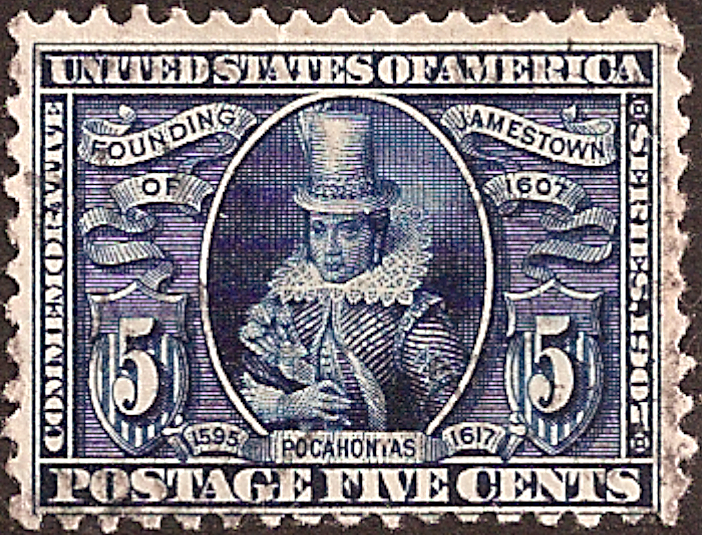
US stamp depicting Pochahontas.
A group of English religious dissidents, puritans, left England in 1609 for The Netherlands but disliked the adoption of Dutch ways by their children and were not beyond the reach of the English authorities there and so, having declined the offer of settlement south of Cape Cod in New Netherland because they wished to avoid Dutch influence, they obtained a patent from the London Virginia Company to settle at the mouth of the Hudson River in the New World. Picking up more colonists in Southampton, the dissidents sailed in 1620 aboard The Mayflower and eventually anchored at what would be Providencetown Harbour on 11 November 1620. 

British stamp of 1970 depicting The Mayflower and the settlers.
US stamp depicting the landing of the settlers.
The arrival of these colonists thus established the north American settlements as places of refuge for political and religious dissidents who were unable to fit in with their societies in their homelands, a pattern that was to be repeated in the establishment of further colonies, as will be seen. The puritan dissidents finally landed at Providencetown 2 days after anchoring and set about rebuilding a shallow draft boat and exploring the vicinity and managing to disturb an Indian grave and stealing corn meant for the dead. It was not long before the colonists were skirmishing with the indigenous inhabitants. The Colonists thus thought it wise to  move on and arrived at Plymouth Harbour and dropped anchor there on 17 December 1620. The first landing party arrived at what would become the settlement of Plymouth on 21 December and, as soon as the weather allowed, began constructing their settlement. During the first winter, 45 of the 102 colonists died. They made their first formal contact with a local native, Samoset, on 16 March 1621and he arranged a meeting with the local chief, Massasoit, and he and the colony's Governor agreed a treaty of peace between the 2 sides. The Mayflower sailed to return to England on 5 April 1621. The remaining 53 settlers celebrated a harvest festival, now celebrated by Americans as "Thanksgiving" in early October 1621 in the company of Massasoit and his men.

US stamp of 1920 depicting the Mayflower at sea.
US stamp of 1920 depicting the landing of the colonists.
In 1624, the Plymouth Company's successor, The Plymouth Council for New England, established a fishing village at Cape Ann which was supervised by the Dorchester Company, originally founded by the work of the puritan John White of Dorchester. This colony failed but White continued his efforts to found a colony in the area and the Council for New England subsequently issued a land grant for an area between the Merrimack and Charles Rivers which was sold to "The New England Company for a Plantation in Massachusetts Bay". In 1630, 140 settlers from south-west England arrived in New England aboard The Mary And John and other ships of the Winthrop Fleet followed it. Massachusetts proved an attractive destination for English puritans in the following years and when civil war broke out in England in the 1640's, the colonists were sympathetic to the Parliamentary cause.

US stamp of 1930 depicting the seal of the colony of Massachusetts Bay.
Not all of the new colonies were founded by protestant puritan dissenters. On 20 June 1632, King Charles I granted a charter for Maryland to Cecil Calvert, Lord Baltimore, who was a Catholic. The name derived from that of the king's catholic wife, Henrietta Maria. About 200 settlers arrived aboard the ships, Ark and Dove, on 25 March 1634 at St. Clement's Island, most of them actually were protestants. Lord Baltimore was given the status of palatine lord and settlers swore allegiance to him rather than King Charles. A Maryland General Assembly was established and an aristocracy took root from those who bought tracts of land from Lord Baltimore who had been awarded the whole of the territory by the royal charter.

US stamp of 1934 depicting the Ark and the Dove.

Sunday, 6 January 2013

192. Recent Bhutan Issues.

Although the Kingdom of Bhutan is not, nor has ever been, a member of The Commonwealth, it has a long history of close relations with, firstly, Great Britain, and after the independence of India, with the latter. Various references state that Bhutan was a Protectorate of Great Britain but that was not its formal relationship, rather it was described as a country with special treaty relationships with Britain. Ugyen Wangchuk had become ruler of Bhutan in 1885 and was elected King in 1907. Three years later he signed the Treaty of Punakha with the British and Britain held responsibility for Bhutan's external relations while the country had internal self-government. At the independence of India, these relations continued with the independent India which recognised the independence of Bhutan but it was only in 1971 when Bhutan became a member of the United Nations. These long-standing close relations with Britain and India make Bhutan a reasonable candidate for Commonwealth membership if it were ever interested in applying to join the organisation. 
  The country did not issue any stamps for use on external mail until 10 October 1962 although fiscal stamps had been used for postage on internal mail from 1954 and in use with Indian stamps on external mail. The first set of definitives consisted of 7 values which depicted local subjects but increasingly, from 1964 onwards, many stamps were issued which had been produced by a New York-based philatelic agency and often their subject matter had little or no relevance to Bhutan. More recently, the Bhutan Post office has changed its philatelic agents and has had a moderately conservative new issue programme usually on subjects of direct national relevance. A number of issues have been about recent political developments in Bhutan such as the introduction of democracy and constitutional monarchy as well as a number of sets on the subject of the Bhutanese monarchy. 
  Exactly one year after the event, on 13 October 2012, 6 miniature sheets were released which commemorated the first anniversary of the wedding of the fifth King of Bhutan, Jigme Khesar Namgyal Wangchuk, who succeeded to the throne in 2006, and his bride, Jetsun Pema:-


  The current monarch succeeded his father, King Jigme Wangchuk, who had ruled Bhutan from 1972 and who is judged by his abdication and his announcement of a general election in 2008 to be the founder of democracy in Bhutan. An issue of 2012 commemorates the former monarch's role in bringing democracy to his country and calls him the "Father of Our Democracy":-


  The present king's wedding was celebrated by the issue of 4 stamps and 4 miniature sheets which were issued on 9 October 2011:-


and the country's international relations were highlighted by a sheetlet of 8 stamps and a miniature sheet which were issued on 16 April 2010 to commemorate the 25th anniversary of SAARC and the holding of a meeting of the organisation in the Bhutanese capital, Thimphu. The stamp designs feature the flags of the member states of the organisation and notably five of the eight are members of The Commonwealth.


  The close relations with India were also commemorated by a set of 4 stamps in sheetlet form and an accompanying miniature sheet which were issued on 15 August 2011 to recall the first visit of an Indian prime minister to Bhutan which took place in September 1958:-


It can be seen that where once Bhutan had a rather poor philatelic reputation, so bad that some of its stamp issues were relegated to the appendix of Stanley Gibbons Stamp Catalogues, its stamps of recent years have been of considerable interest and great relevance. Recent issues have been relatively conservative but exciting in design and very well printed. Issues since 2010:- 14 February 2010: Lunar new year (2 miniature sheets); 7 April 2010: World Health Day (6 stamps and 1 m.s.); 16 April 2010: Silver jubilee of SAARC (see above); 1 November 2010: 2nd anniversary of the coronation of King Jigme Khesar Namgyal Wangchuk (18 stamps and 2 m.s.); 17 December 2012: Queens of Bhutan (8 stamps); 17 December 2012; The Wangchuk Dynasty (6 stamps); 3 February 2011: Lunar new year (2 stamps); 25 May 2011: 25th anniversary of diplomatic ties with Japan (4 stamps); 15 August 2011: Visit of the Indian prime minister (see above); 9 October 2011: Bhutanese Royal Wedding (see above); 2012: Education (1 stamp and 1 m.s.); 2012: Lunar new year - year of the dragon (1 stamp and 1 m.s.); 2012: The Father of Democracy (see above) and 2012: 1st anniversary of the Royal Wedding (see above). As an adjunct to a collection of Commonwealth stamps, a collection of stamps from this country is full of interest and it is not too expensive to obtain the recent issues. I have made a collection of Bhutanese stamps up until 1971 because in many ways the territory was then closely linked to India and I have collected stamps issued over the past few years which are relevant to the country which, as I try to illustrate above, is true of pretty well every stamp issued by Bhutan in recent times. Perhaps Bhutan will one day apply for Commonwealth membership given its links to the SAARC nations, its previous close relationship to first Britain and then India and its now burgeoning democracy which is one of the great principles of Commonwealth membership.


Flag Counter

191. Mozambique's Diamond Jubilee Issue and Cyprus' Silver Medallist.

Although 2012 is now behind us, there are some residual items to mention from the big issues of the year - the Queen's Diamond Jubilee and the London Olympic Games. Stamperija has released the designs of a sheetlet of 6 stamps and a miniature sheet to celebrate the Diamond Jubilee:-


This subset was issued as part of a series entitled "Anniversaries part 3" with an issue date given as 30 June 2012. Most of the issue, as usual, is irrelevant in subject matter to Mozambique itself though you may think that as a member of The Commonwealth, the diamond jubilee of the Head of The Commonwealth is a subject worthy of commemoration by Mozambique. Other subjects in this set are also commemorated with 6 stamps and a miniature sheet and are:- 180th anniversary of Edouard Manet, French artist;  Liu Yang, first Chinese female astronaut; Birth centenary of Paul Jackson Pollack, American artist; Mohandas Gandhi, Indian statesman (bizarrely the stamps do not depict Gandhi himself but the British actor, Ben Kingsley, in the role of Gandhi in the movie of that name); "Peacemakers" (including Pope John Paul II, Kofi Annan and so on), Elvis Presley, American musician; Death centenary of Hubert Latham, aviator; the Kruger National Park, South Africa and an issue which may have some relevance to Mozambique; the 50th anniversary of the Pan African Women's Organisation:-


Meanwhile, another Commonwealth country, Cyprus, issued a single stamp on 7 November 2012 to commemorate an Olympic medal winner - Pavlos Kontides who won a silver medal in one of the sailing events. Cypriots were very proud that a representative of their small country had achieved such a sporting success:-


I also like Cyprus' Christmas stamps which were released on 14 November 2012 and which have depictions of the Madonna and Child:-


Saturday, 5 January 2013

190. South Africa and Sri Lanka Issues of 2012.

During 2012, South Africa has issued a number of worthwhile stamps, some with interesting and original designs. A miniature sheet was issued on 6 September 2012 to commemorate the 360th anniversary of the landing of the Dutch at The Cape:-


The excellent and free South Africa Post Office philatelic magazine, Setempe, details the story behind the stamp and points out that the Dutch did not originally intend to colonise South Africa, they merely wished to establish a staging post for their ships sailing around The Cape en route to the East Indies, the base of the spice industry. However the staging post needed to trade with the local inhabitants, the Khoikhoi, but the Dutch East India Company, the VOC, wished to restrict contact between the Khoikhoi and the Company's employees so the Dutch were not able to employ the Khoikhoi and so there was a labour shortage. Thus, some of the Dutch established farms in the area to produce the necessary crops for the Company's ships to be provisioned with and as the number of these "Free Burghers" increased so they expanded the territory they worked northwards and eastwards over the lands of the Khoikhoi. Krotoa, a Khoikhoi woman born around 1642, was employed as an interpreter by Jan van Riebeck, the first Dutch Governor of The Cape, and became the first Khoikhoi woman to be named in the European records of South Africa. She was baptised as a Christian on 3 May 1662 and married Peter van Mierhoff, a Danish surgeon, on 26 April 1664, this being the first recorded marriage between a European and a Khoi at The Cape. Krotoa and her husband moved to Robben Island and had a family but Peter died in 1688 while on an expedition to Madagascar. Krotoa had 3 surviving children but sadly she became an alcoholic and was imprisoned on one occasion for disorderly behaviour. She died on 30 September 1874 at The Cape. Because of Krotoa's historic role in establishing a relationship between the Dutch and the indigenous peoples of The Cape, a portrait of her is featured on the miniature sheet along with a VOC ship. The item was designed by Lien Botha.
 Other issues of 2012 are:- 6 January: Centenary of the SANNC (1 stamp); 22 February: Commemoration of Rev. John Dube (1 miniature sheet); 2 April: George Pemba centenary (10 stamps)l 20 April: South African national symbols (8 stamps):-

18 May: Commercial and medicinal plants (10 stamps); 5 June: Astronomy and the Transit of Venus (11 stamps):-


6 June: Centenary of the University of Cape Town's Faculty of Health Sciences (1 m.s.); 12 July: Big Five animals babies (5 different designs in a booklet); 10 August: sunbirds (5 stamps); 21 September: Heritage sites: Vredefort Dome, the world's oldest astrobleme - part of a meteorite impact structure (5 stamps); 9 October: National Post Day - the South African Field Postal Unit, 11 FPU which currently has 8 active Forces post offices on Africa - 3 in Democratic Republic of Congo, 2 in Sudan and 1 in the Central African Republic as well as the base at Waterkloof. The issue consists of an excellent Africa-shaped miniature sheet which contains 10 different stamps:-


26 October:- Centenary of the Township of Alexandra in Johannesburg (5 stamps in a sheetlet).
  Some stamps from Sri Lanka are slow to find their way to new issue dealers - I have just obtained an example of the miniature sheet which was issued on 28 October 2011 which depicts vintage and classic cars:-


Also slow to arrive has been the miniature sheet issued on 21 January 2012 which depicts "Legends of Sinhala Cinema":-


and there are still quite a lot of 2012 issues to arrive. Issues from the last quarter of the year are:- 11 September 2012: Colonial buildings (4 stamps and 1 m.s.); 1 October: World Children's Day (1 stamp); 6 October: World Post Day (1 stamp); 7 October: Flowers (4 stamps and 1 m.s.); 16 October: 60th anniversary of WHO activities in Sri Lanka (1 stamp); 31 October: 50th anniversary of Sri Lanka Insurance (1 stamp); 2 December: Christmas (2 stamp and 1 m.s.); December: Definitive stamps (3 sheetlets, each with 4 different designs) and also in December: Aircraft (4 stamps and 1 m.s.).

Wednesday, 2 January 2013

189. What Stamps Tell Us.

You do not really expect to see a stamp from Cuba in a blog about Commonwealth stamps but this single stamp issued during 2012 by the only communist state in the western hemisphere (unless you include Venezuala) startled me when I first noticed it on a dealer's website. The flag of Cuba is shown amidst the national flags of 6 tiny Commonwealth Pacific island states - Kiribati, Tonga, Cook Islands, Nauru, Solomon Islands and Fiji and the the item commemorates the 10th anniversary of Cuba's diplomatic relations with the small nations. I was surprised to discover that Cuba had diplomatic relations with these small territories separated from it by a whole continent and a wide expanse of ocean. However, on further research, I discover that Cuba established diplomatic relations with Nauru in 2002 and with The Solomon Islands in 2003. Even before that, relations were established between Cuba and Vanuatu as long ago as 1983 (though Vanuatu is not included among the nations featured on this stamp). Formal diplomatic relations with Tonga, Samoa and Fiji were established in 2009 (although Samoa, like Vanuatu, is not mentioned on this particular stamp). Various Oceania presidents have paid state visits to Havana (President Anote Tong of Kiribati has paid 2 such visits) and Cuba provides the various territories with useful aid, particularly in the delivery of medical care in the islands. Cuba supplies several of the countries with doctors and takes medical students from the tiny countries to study medicine in Cuba. Cuban intervention in the medical care system in Kiribati is said to have reduced mortality rates there by 80%.
 Meanwhile, another diplomatic relations stamp has been issued - by Mauritius - as part of a set of 3 "anniversaries" stamps which was issued on 9 October 2012. This Rs14 value commemorates the 40th anniversary of its diplomatic relations with The People's Republic Of China and depicts the national flags of Mauritius and China. I have previously commented that the Chinese are very astute at the use of stamps in promoting their international relations, even - as we well know - donating to The Republic of South Sudan its first sets of stamps after the achievement of independence. A few other postal administrations could learn lessons from the Chinese in the use of stamps in the promotion of their international relations but I suppose most western post administrations are too obsessed with the production of excessive issues on trite subjects in the pursuit of financial profit to realise this.


The stamps that countries produce (or have produced for them) tell us such a lot about the countries themselves such as how the little nations of the Pacific area appear to be forging close relationships with Cuba or just how many are prepared to advertise their close links with China. Stamps certainly give you an appreciation of what is happening in the world, things that you might otherwise never have noticed. Perhaps the Foreign and Commonwealth Office ought to have a philatelist-in-residence to keep an eye on what the world's stamps are telling us!

188. Tuvalu Sees Out Diamond Jubilee Year.


With the official date of issue for Royal Mail's new definitive stamps being 3 January 2013, I was somewhat surprised to find the set I had ordered from the Philatelic Bureau being delivered to me in the post on 2 January 2013. I suppose, if I could be bothered, that I could affix these to an envelope and get a postmark cancelling them showing that they were used one day before they should have been, but frankly I'm not sure that I really care. The set comprises the usual Machin designs on self-adhesive paper but with four values in new colours (1st, 1st large, 50p and £1.00).


Additionally, the 1p, 2p, 5p, 10p and 20p definitives are reissued with a security overlay added to them for the first time. All stamps were photogravure printed by De La Rue and all of them have the security code M12L except the 1st large which has the code MA12. Additionally, also released on 3 January 2012 (or in my case, 2 January), are 3 retail booklets of the 1st class stamp in its new colour: 6 x 1st, 12 x 1st and 4 x 1st large. Both the 1st and 1st large booklet stamps have the security code MA12.


Queen Elizabeth also features on a new definitive stamp from Canada which will be issued on 14 January 2013. In the denomination of the permanent domestic rate, it is self-adhesive and sold in booklets of 10 stamps and was lithographed by the Canadian Bank Note Company:-


On the same date, Canada will also issue 5 Permanent domestic rate stamps in the Canadian Pride series, again lithographed by Canadian Bank Note, and issued in self-adhesive booklets of 10 or 30 as well as in a gummed miniature sheet. Again, on 14 January, the Baby wildlife definitive series continues with 4 values- Permanent domestic rate, $1.10, $1.34 and $1.85. The domestic rate value is sold in coils of 100 stamps and the higher values as coils of 50 stamps and booklets of 6 stamps (all self-adhesive). There is an accompanying gummed miniature sheet:-


Canada's first issue of the new year is to be issued on 8 January 2012 to commemorate the lunar new year of the Year of the Snake. There are 2 values:- Permanent domestic rate, produced gummed in a sheet of 25 stamps, and $1.85 value, sold as a self-adhesive in booklets of 6 stamps or in a gummed souvenir sheet:-


The 1.85 value is also included in a "transitional sheet" of 2 stamps, the other design featuring a dragon to mark the end of the Year of the Dragon:-


Tuvalu issued the last of the diamond jubilee sets of 2012 when it released a sheetlet of 4 stamps and a miniature sheet on 31 December 2012 which was cutting it rather fine:-


It appears that some British dependencies failed to philatelically commemorate their monarch's diamond jubilee during 2012 including The Virgin Islands, Anguilla and the British Antarctic Territory. Likewise, there were no issues from the Australian territories of Christmas Island and Cocos (Keeling) Islands. Most of the Queen's Realms issued commemorative stamps for the event but notably Jamaica did not. A number of other Commonwealth territories which have tended to jump on the Royal Omnibus bandwagon in the past have also failed to issue stamps this time round. Perhaps they will issue stamps during 2013 to commemorate the 60th anniversary of the Queen's coronation.