Showing posts with label Barbuda. Show all posts

Tuesday, 29 December 2015

687. The Normans Take England.


  I have just finished reading a book (in the Penguin Monarchs series and written by John Gillingham) about King William II, known as Rufus, who is one of those kings of England about whom almost everyone knows very little except that he was killed by an arrow shot in the New Forest in Hampshire which was a good thing because he was a thoroughly unpleasant sort of fellow.
  Certainly the impression of Rufus from Gillingham's book is much more positive and demonstrates that he was far more interesting than just being someone whose manner of death is the only notable thing about him. He seems to have had a bad press from writers who lived shortly after his death rather than those who actually lived during his reign and then mainly because he upset leaders of the Church. 
  He was the third son of the rather more unpleasant William I who had usurped the English throne by invading the country and killing King Harold II and then replaced the English lords with his Norman cronies and, finally, when English resistance grew to his regime, viciously brought death and destruction to the country with the English north being most scarred by The Conqueror's terror.
  Rufus proved adept at using the wealth of England to fund armies and buy off enemies to gain territory in France - in Maine and the Vexin - and eventually gained control of Normandy itself when his brother, Duke Robert, set off to the Holy Land on Crusade. He was less successful in crushing the Welsh but he established English settlers in Cumbria which he gained from the Scots and had influence in Scotland itself.
  He never married and had no children, neither legitimate nor illegitimate. He appalled the clergy who abhorred the fashions of his reign where men, they felt, wore effeminate clothes and long hair in the style of women. 
   He died at the height of his power in 1100, aged about 42. An influential English writer saw him as an oppressor of the Church while the Normans viewed him as a strong ruler and a chivalrous soldier and leader. His death may or may not have been assassination with his brother Henry or the King of France or his son Louis behind any plot.
   Henry, whether or not he was responsible, acted quickly after Rufus' death to grab the crown of England and at his coronation published a charter which stated "I abolish all the evil practices by which the kingdom of England has been unjustly oppressed, and I set out some of those evil customs here". It was useful for the younger brother to blacken Rufus' name.
  The British stamp dealer, Captain Charles McMiram, was allowed to establish a philatelic agency for Barbuda in 1968. It appears that McMiram was a student of the British monarchy and so determined to issue a series of stamps on that subject and 1 stamp was consequently released fortnightly beginning with a depiction of William The Conqueror which was issued on 16 February 1970. 
  Naturally the second in the series (issued 2 March  1970) portrayed William Rufus and it is remarkable to me what a good stab at a portrait of the "Red King" McMiram's artist made. The picture (see above) showed Rufus looking appropriately ruddy-featured and notably with the very long hair that had scandalised the contemporary clergy but perhaps rather older than a man who lived only to be 42 might have done though if he was as debauched as his critics make out then perhaps the appearance in the portrait is not as unreasonable as might first be thought.
  McMiram was faced with a similar problem right at the start of the series - no contemporary portrait of William I existed and so he opted to have the artist who designed the stamp use a portrait of himself to represent The Conqueror. Hence, even if the series does not accurately depict all the English monarchs from the end of 1066 onwards, there is one stamp dealer whose face appears in the ongoing issue! A lovely story, I think.


   Of course, 14 October 2016 will be the 950th anniversary of the Battle of Hastings when Norman rulers and Norman aristocracy grabbed power over the English and the country's wealth. As I have previously pointed out, Royal Mail does not intend to release a set of stamps to commemorate this notable anniversary although a 1980's popular music group, Pink Floyd, is to be honoured with a Royal Mail stamp issue despite having received philatelic acknowledgement from the British postal service on 2 former occasions. Instead of a set of stamps to commemorate the battle, a ridiculously overpriced "Commemorative sheet" will be released on 14 October 2015. I have long given up buying such items and so I will have no commemoration of the 950th anniversary of the Battle of Hastings in my British stamp collection but at least I can fall back on admiring the Pink Floyd  stamps - if I decide that money should be spent buying them and at that is not for sure at this stage.
  It may well be time to follow the same plan with my Royal Mail collection as I already follow with issues from Isle Of Man, Jersey, Guernsey, Gibraltar, Australia and so on - only buy new issues which commemorate notable anniversaries or events of local relevance. 2016 may well be the time to start following such a plan with British new issues. The Pink Floyd issue would certainly be one of the first sets to be omitted from my collection. 
  Back to the Normans - one of my favourite British sets of all time is that which was released in 1966 to commemorate the 900th anniversary of the Battle of Hastings. Designed by the incomparable David Gentleman the issue was released on the precise anniversary of the Battle of Hastings - that is - 14 October 1966 and copies the style of the Bayeux Tapestry with 6 of the values produced in a se-tenant strip illustrating the progress of the battle.

The Norman invasion fleet at sea.

The death of the last English king, Harold II.

The Normans slaughter the English.

The Normans attack!

  One of the consequences of the Norman Duke's seizure of the English throne was that the Channel Islands became linked to the English monarchy. Guernsey Post will issue a set of stamps on 25 May 2016 to commemorate the 950th anniversary of the Battle of Hastings (why so long before the actual anniversary?) but the issue will be inscribed "Alderney". On 27 July 2015 Guernsey Post will then issue a set of stamps on "The History of the British monarchy". This set is also to be inscribed "Alderney" and could also be linked to the Battle of Hastings anniversary.
  The first definitive set of the independent postal administration of Guernsey issued on 1 October 1969 included in the stamp designs various portraits of a number of English and British monarchs taken from coinage. The halfpenny value included a portrait of King Harold II's immediate predecessor, Edward The Confessor, whom the Norman Duke had claimed had bequeathed the throne of England to him. The 1d and 1/6d values depicted William I himself with a nose shaped similar to Captain McMiran's but the face altogether thinner.

Edward The Confessor

William The Conqueror


   The Normans altered the lives of the unfortunate English forever and changed the English people's future dramatically and irretrievably. No king of England would ever again have a fatherline descended from the English genes brought over from Angeln when the English first came to Britain after the Roman withdrawal from the islands. And if that's not worth a special stamp issue I don't know what is.  But very few stamps have appeared from Royal Mail or the British Post Office over the years which illustrate aspects of the Anglo-Saxon period and there seems little chance of that omission being corrected in the foreseeable future.


Sunday, 8 February 2015

503. King John.


  2014 is to be an important year for unpleasant former English kings. Firstly, the funeral of the monstrous Richard III will take place at Leicester Cathedral on 26 March 2015 (see Blog 437) and then attention moves to the worst of them all, Bad King John, when the 800th anniversary of his consenting to the Magna Carta will be commemorated.  
  Royal Mail has wisely decided not to commemorate the funeral of the murderous Richard III although, as mentioned in Blog 437, he has been featured previously on a British stamp but the main British postal service will release a set of stamps on 7 June 2015 to commemorate Magna Carta. I do not know whether King John will feature in any of the designs of the stamps in the set but as many other murderous, villainous and, sometimes, inconsequential monarchs have been depicted on British stamps I hope that John will indeed make his first appearance in my British stamp collection. 
  John was born in Oxford on Christmas Eve 1167 as the youngest son of King Henry II and Eleanor of Aquitaine. With three much older brothers, it appeared unlikely that John would succeed to a significant inheritance and he was known as John Lackland. 
  However he succeeded his brother, Richard I, to the throne of England in 1199. He also became ruler of the "Angevin Empire" - about one third of France (see Blog of 4 July 2010) - but his nephew. Arthur, rebelled against him in an attempt to take over the territories in France. Arthur was captured and was killed possibly by John himself in 1203. 
  Subsequently John lost Normandy and the Angevin territories to the French and John failed to recover them. John fell out with the Pope, Innocent III, over the appointment of a new Archbishop of Canterbury so that the Pope eventually placed England under an interdict in 1208 and John eventually submitted to Innocent III in 1213 and agreed to England becoming a Papal Fief.
  With the various attempts to recover the territories in France, John implemented a fiscally harsh regime in England and civil war began as the barons opposed his actions. John lost control of London to the rebels on 17 May 1215 and was forced to give assent to the demands of the rebel lords in the Magna Carta at Runnymede on 15 June 1215. The terms of Magna Carta were so extreme that John gained fresh support and was able to restart the civil war against the rebel lords and the the barons invited the French Dauphin to come over to England and take the throne from John. However the king died of natural causes on 19 October 2016 having lost the crown jewels while crossing The Wash a few days earlier and was buried in Worcester Cathedral and succeeded by his nine year old son, Henry III.
  John has made a number of previous appearances on Commonwealth stamps and depicted above is the only contemporary portrait of him which takes the form of a depiction on an English coin. The coin appeared on the 2d value of the first Guernsey definitive series which was issued on 1 October 1969 and designed by Richard Grainger-Barrett and printed in photogravure by Harrison. 


  The above painting of King John which is in the National Portrait Gallery was reproduced on a stamp issued by Jersey on 25 June 2004 to commemorate the 800th anniversary of Jersey's status as a Royal Peculiar. The stamp was issued as a se-tenant pair with a picture by Victor Ambrus of Mont Orgueil Castle in the 13th century:-


  The same portrait was also used on one value of a set of 8 stamps depicting British monarchs issued by Solomon Islands on 24 April 2010. The issue does not appear to have commemorated any particular event or anniversary and was effectively nothing more than a catchpenny issue from a country which did not become part of the British Empire until 700 years after the reign of King John;-


  I have one other philatelic item in my collection which depicts the same portrait of King John. The item is a cover with a "silk " illustration of the king with a contemporary 8p Machin Head definitive and a souvenir "WINDSOR BERKS" postmark dated 15 JUN 1978 (the anniversary of John's assent to Magna Carta). This cover was one of a series, each depicting a portrait of a different English monarch from William I to Elizabeth II, which was privately produced by the dealer Henry Murray to commemorate the 25th anniversary of the coronation of Queen Elizabeth II. An edition of 1500 of each cover was produced and they were sold with a special album to house them. It provides an interesting collection of portraits and relevant postmarks although there is one startling error in the set - the portrait used on the Henry IV cover does not depict Henry Bolingbroke but instead features in error a portrait of Henry IV of France!


  An imaginative portrait of John was used for the design of the seventh stamp of the Kings and Queens series of stamps which was issued by Barbuda on 15 May 1970. The portrait is based on the effigy on John's tomb in Worcester Cathedral:-


  Gibraltar depicted John on one of 2 stamps issued on 26 August 1968 to commemorate Human Rights Year. Famously, the stamp depicted an error by the designer, Alfred Ryman, because it showed John with a large quill pen in his hand suggesting that he signed Magna Carta whilst he did in face give his consent to the charter not by signing it but by applying his seal to it:-


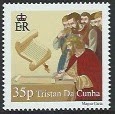
  Tristan Da Cunha released one stamp on 24 April 2011 which was part of a set of 8 stamps which made up its "British History Part 3" issue. The stamp depicted King John examining Magna Carta with his barons looking on:-


  A commemoration of Magna Carta was the subject of one of the stamps which made up the 7th issue of the Royal Mail Millennium series of 1999. This part was released on 6 July 1999 and showed an unexciting work by Alan Kitching called "First Rights". The design highlighted a modern interpretation of the rights granted by John in the Magna Carta:-


   As noted above, John died on 19 October 1216 and was buried in Worcester Cathedral which was depicted on a Universal Mail United Kingdom Airmail Postcard stamp (UK0048) issued in 2012 (see Blog of 29 September 2012):-


  Finally, no-one can be all bad and, being a great dog enthusiast, I find the picture illustrated below reassures me that even King John might have had a fraction of kindness inside him. The illustration from a royal manuscript of c.1307 - 27 in the British Library shows the king stroking affectionately one of his dogs while another sits trustingly beside him - as I say - King John must have had a little crumb of kindness in him even if it was reserved for his dogs:-


Flag Counter

Wednesday, 4 December 2013

333. Turbulent Priests.


Canterbury Cathedral.

  In recent years many stamps have been issued by or on behalf of various Commonwealth postal administrations which illustrate the leaders of the Roman Catholic Church and commemorate numerous Papal events, frequently of no direct relevance to the country whose name appears on the stamp. In Blog 216 which coincided with the election of Pope Francis, I illustrated some stamps from Commonwealth countries which depicted the various Popes who have occupied the See of Rome since 1900. Of equal relevance as the leader of the Roman Catholic Church to many Commonwealth countries is the most senior cleric in the Anglican Church, The Archbishop of Canterbury. There have been a number of stamps issued in recent years which commemorate the men who have occupied that post and I illustrate them below.
  The first Archbishop of Canterbury was Augustine, an Italian monk sent by Pope Gregory The Great to convert the people of Kent to Christianity. He arrived in 597 AD and founded a church at Canterbury where, after a short time, Aethelbert the King of Kent was baptised and he was followed by many of his people. Augustine founded 2 more sees at Rochester and London in 604 but died on 26 May 606 and was succeeded by another Italian, Laurentius. There was no native English Archbishop of Canterbury until 655 when Deusdedit (Frithine) became the sixth Archbishop of Canterbury. Augustine was depicted on 2 stamps issued by Royal Mail on 11 March 1997, the 43p also including a depiction of the Kentish king, Aethelbert.

Augustine and Aethelbert

St. Augustine of Canterbury.
  We move on to the period after the Norman conquest of England and the reign of Henry II. In 1162, Thomas Becket, Henry's Chancellor and a former protege of the previous Archbishop of Canterbury, Theobald of Bec, was appointed as the new Archbishop. However, eventually a running dispute began  between the king and primate and eventually, in December 1170, four of Henry's knights murdered Becket inside the cathedral at Canterbury, Henry having been said to have asked "Who will rid me of this turbulent priest?" The king paid penance for the murder and Becket was made a saint and his shrine at Canterbury became a great site of pilgrimage in the middle ages. Becket's murder is featured on a stamp issued by Tristan Da Cunha on 15 January 2010 and King Henry was depicted on a stamp issued by Barbuda on 15 April 1970:-

The murder of Becket.
King Henry II
King Richard II
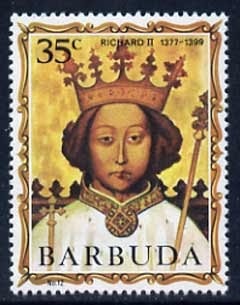
  Another unfortunate Primate who met a bloody end was Archbishop Simon Sudbury who took up the post on 4 May 1375 and was the leader of the Church during the reign of King Richard II (illustrated above on one of the Barbuda Kings and Queens set which was issued on 1 August 1970) - he suffered the fate of being beheaded by rebels on 14 June 1381 during the Peasants Revolt. The revolt itself was featured on a stamp issued by Tristan Da Cunha on 15 January 2010 and the stamps show the boy king Richard on horseback facing down the rebels with the city of London in the background:-

The Peasant's revolt 1381

  We move forward to the reign of Henry VIII who had grown tired of waiting for his first wife, Catherine of Aragon, to produce a male heir to the English throne and thus secure the future of the Tudor dynasty. He had developed a passion for a woman called Anne Boleyn and resolved to marry her but it was first necessary to have his marriage to Catherine annulled, something which the Pope would not allow him to do. In 1532, a reformist priest, Thomas Cranmer, was appointed to be Archbishop of Canterbury. In 1533, a court established by Cranmer ruled that the marriage between Henry and Katherine was against the laws of God because Katherine had first been married to Henry's teenage brother, Arthur, and the marriage was annulled. Cranmer worked to reform the Church in England and eventually it broke with Rome and Henry VIII became the Head of The Church Of England. 

Thomas Cranmer.
King Henry VIII.
  Henry was succeeded by his 9 year old son, Edward VI, who was a fervent Protestant and great reforms in The Church continued. Cranmer made a significant contribution to the preparation of The Book Of Common Prayer which was published in 1549. However, Edward VI died in 1553 and eventually his Catholic sister, Mary known as "Bloody Mary", managed to seize the throne and Cranmer's fate was sealed. He was arrested for treason later in 1553 and deprived of the Archbishopric by Rome in December 1555. He was first imprisoned in the Tower Of London and later in Oxford where he eventually recanted of his Protestant beliefs.

King Edward VI.
  However, Mary's vicious regime condemned the 66 year old man to be burned at the stake and this was carried out on 21 March 1556 although Cranmer rejected his recantations and plunged his right hand into the flames first because that had been the part of his body which had signed the recantation. Mary's vengeful triumph was complete but did not last long as she herself died 2 years later and was succeeded by her Protestant sister, Elizabeth I.

Bloody Mary
Queen Elizabeth I

  John Bancroft was Archbishop of Canterbury from 1604 to 1610 and he was the chief mover of The Authorised Version of The Bible which was published in 1611 and is often known as the King James Bible. A rather poor rendition of King James holding the new Bible was depicted on one of the Millenium Christmas stamps issued by Great Britain in December 1999:-

King James I and the King James Bible.
  Yet another Archbishop Of Canterbury to meet a grisly end was William Laud who was appointed as Archbishop in 1633 during the reign of Charles I. The puritans feared that Laud was sympathetic to the restoration of Catholicism and eventually had him arrested and had him put on trial. They failed to convict him and condemned him by an Act of Attainder and finally succeeded in having him beheaded in 1645, just 4 years before the King himself was to suffer a similar fate at the hands of Parliament.

King Charles I - beheaded as was Archbishop William Laud.

  We move ahead in to the 20th century. Archbishop Cosmo Lang played an important role in bringing about the abdication of King Edward VIII in 1936. Lang was dismayed at the new king's evident determination to marry the American divorcee, Wallis Simpson, and, greatly due to the intervention of Archbishop Lang, Edward VIII eventually abdicated on 11 December 1936. Shortly afterwards Lang broadcast a speech in which he said about the former king, "From God he received a sacred and high trust. Yet by his own will he has....surrendered the trust" and that Edward had had a "craving for private happiness" which he had sought "in a manner inconsistent with the Christian principles of marriage". The speech shocked the British public and was widely condemned for its lack of charity and was said to have dealt "a disastrous blow to religious feeling throughout the country".
  Although there has been no philatelic depiction of Archbishop Lang, King Edward VIII has appeared on a number of stamps including 4 definitive stamps issued by Great Britain in 1936 and a more recent British stamp issued on 2 February 2012 which was part of a set of 5 stamps which depicted British monarchs of the Houses Of Windsor and Saxe-Coburg-Gotha.


  I was also unable to resist reillustrating one of the hilarious stamps from Guyana which were issued in 2012 which depict not Edward VIII but Edward XIII. It appears that Cosmo Lang was responsible for causing the deposition of 2 King Edwards rather than one if the Guyana Post Office is to be believed or  more likely the designers who work for the large New York agency which produced these items just don't understand Roman numerals!:-


  Cosmo Lang was succeeded by William Temple in 1942 and he by Geoffrey Fisher (1882-1972) in 1945. He appears on a number of Commonwealth stamps because he was the Archbishop of Canterbury who crowned Queen Elizabeth II at her coronation on 2 June 1953. Royal Mail depicted Archbishop Fisher standing to the left of the Queen on 1 of 10 stamps issued in 2003 to commemorate the 50th anniversary of the Coronation. Other scenes of the Coronation in which Archbishop Fisher appears were also released by a number of other Commonwelth territories including Dominica and Pitcairn on the occasion of the 25th anniversary of the event:-


  Archbishop Fisher retired from the primacy in 1961 and was succeeded by Michael Ramsey who also appears on the above stamps but standing to the Queen's right (at the time of the coronation Ramsey was Bishop of Durham and then was made Archbishop Of York in 1956 and subsequently Archbishop Of Canterbury). Archbishop Ramsey was succeeded by Donald Coggan in 1974 and he in turn by Robert Runcie in early 1980. A set of stamps issued by Ghana on 3 March 1981 depicts Archbishop Runcie sitting with President Hilla Limmann and Pope John Paul II during the Papal visit to Ghana which took place from 8 to 10 May 1980 and when the newly appointed Archbishop was also visiting that country:-


  Subsequently, Belize issued a pair of stamps on 8 March 1984 to commemorate the visit of Archbishop Runcie to that country although the issue consisted of overprinted definitives rather than a portrait of the primate and did not even give the Archbishop's name:-


   Archbishop Runcie was succeeded by George Carey in 1991 and 2 portraits of him were featured on stamps of Seychelles issued on 18 June 1993 to commemorate the Archbishop's visit to the islands:-


  Carey was succeeded by Rowan Williams in 2002 but I am not aware of any stamps having been issued which featured him (see addendum at the end of this piece) but his successor, Justin Welby, who became Archbishop in February 2013, has already made a philatelic appearance - on a label attached to a 2013 Christmas stamp issued by Tristan Da Cunha on 18 November 2013. The stamp itself depicts Canterbury Cathedral:-


  The portrait of Archbishop Welby featured on the label shows how remarkably he resembles Archbishop Carey as depicted on the Seychelles stamps depicted above.

  Addendum - The 104th Archbishop Of Canterbury, Dr. Rowan Williams, finally made an appearance on a Commonwealth stamp when Zambia depicted him meeting the former President of Zambia, Dr. Kenneth Kaunda, on one of the stamps included in a miniature sheet of five which was released on 23 October 2014 to commemorate the 50th anniversary of Zambia's independence. The photograph used in the design was taken in April 2011 when the Archbishop made his first visit to Zambia:-

Archbishop Williams with Dr. Kaunda.

Coloured version of the photograph used for the Zambia stamp.

  Addendum 2 - Stephen Langton 1207 - 1228. See Blog 594.

Stephen Langton and King John.


Flag Counter