Friday, 16 January 2015

512. Birds From Falkland Islands, World War II From Isle Of Man And Gold From Malaysia.


  Another lovely set from the Pobjoy Stamps/Creative Direction stable - this time from Falkland Islands - to be issued on 11February 2015 on the subject of Birds And Their Young (depicted above).
  In Blog 511 I mentioned the new Isle Of Man Post issue due to be released on 17 February 2015 to commemorate the 175th anniversary of the Penny Black and there is now another issue to mention - 2 miniature sheets which will be released on 26 February 2015 to commemorate the 70th anniversary of Allied victory in the Second World War. The designs of the stamps which are in the VJ Day miniature sheet are taken from original artworks by James Fenton, a resident of Port Erin, which reflect his wartime experiences and depict a Burmese Gurkha and a British soldier, the 2 stamps being joined by a label which depicts the Burma Star medal. The miniature sheets were designed by Isle Of Man Advertising and lithographed by BDT International:-


  A surprising philatelic item from Pos Malaysia was released on 1 December 2014 which took the form of a postally valid RM50 stamp made from 22k gold plated copper. The design repeats that of one of the Baba and Nyonya heritage stamps of 2013 and was designed by Reign Associates and printed by metal stamping by Cartor. The stamp was issued in a special pack in an edition of 5000:-


  I have previously detailed the Hong Kong Post Lunar New Year issue for 2015 in Blog 479 and simply repeat here the designs of the the basic set of four which will be released on 24 January 2015:-


Flag Counter

Thursday, 15 January 2015

511. New Issues Feature Penny Black, Gandhi And Medicinal Plants.

  
  Isle Of Man Post will issue a set of 6 stamps on 17 February 2015 to commemorate the 175th anniversary of the world's first adhesive postage stamps, the Penny Black and the Twopenny Blue. Strangely the issue will also commemorate a less notable anniversary - the 175th anniversary of the birth of the British philatelic dealer, Stanley Gibbons. The issue was designed by Leanne Sherliker and lithographed by BDT International. The £2.30 value suitably depicts a Penny Black used on a cover to an address in the town of Ramsey and the £1.60p also depicts a Mulready cover (an item of pre-paid postal stationery issued along with the Penny Black) to an Isle Of Man address in Douglas:-


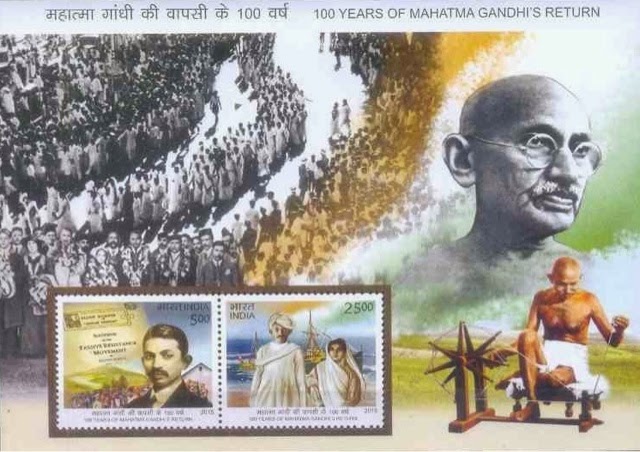
  India Post issued 2 stamps and 1 miniature sheet on 8 January 2015 to commemorate the centenary of Mohandas Gandhi's return to India in 1915 after spending 21 years in South Africa where he developed his political views and leadership skills:-


  In Blog 506 I depicted the Collector's sheet issued by Singapore Post on 9 January 2014 to commemorate  the Lunar New Year which is the Year of the Goat. I now depict the set of three stamps  issued along with the sheet :-


  Pos Malaysia will issue a set of 3 stamps and 1 miniature sheet on 20 January 2015 as the second part of its ongoing Medicinal plants series. The issue was designed by Reign Associates and printed in lithography by Malaysia Security Printers:-


Flag Counter

Wednesday, 14 January 2015

510. New Zealand Post Miniature Sheet For Cricket World Cup.


  New Zealand Post will commemorate the ICC Cricket World Cup to be held in New Zealand and Australia with a miniature sheet of 14 x 60c cricket ball-shaped self-adhesive stamps. The stamps feature the flags of the participating countries - India, England, South Africa, Pakistan, United Arab Emirates, Sri Lanka, West Indies, Afghanistan, Ireland, Bangladesh, Australia, New Zealand, Zimbabwe and Scotland (the West Indies and Ireland flags are team flags rather than national flags). The item was designed by New Zealand Post and lithographed by Southern Colour Print and will be issued on 4 February 2015 (depicted above).
  New Zealand Post will issue another miniature sheet on 4 February 2015 to commemorate the 175th anniversary of the Treaty of Waitangi between the British and Maori chiefs which is viewed as the document which established New Zealand as a political entity. The miniature sheet was designed by Rangi Kipa, Taranaki Tuturu and Roy McDougall and lithographed by Southern Colour Print:-


   An end of year new issue spree from several of the territories for which CASCO serves as philatelic agent includes a Christmas issue from Jamaica Post consisting of 3 stamps and 1 miniature sheet which were released on 11 December 2014. The set also commemorated the 350th anniversary of St. Andrew's Parish Church in the village of Half-Way-Tree:-


  The correct face value of the miniature sheet is $200:-


   The Barbados Postal Service issued 4 stamps and 1 miniature sheet on 13 December 2014 on the subject of gardens of Barbados:-

The complete set of four.


  Bermuda issued a block of 10 different stamps and 1 booklet containing a pane of the 10 stamps in a different arrangement on the subject of Bermuda roses during 2014. The face value of the stamps is described as "Zone 1". I believe that the date of issue was 16 October 2014:-


Booklet cover.

Contents of booklet.

  The Saint Helena Post Office And Philatelic Bureau issued 3 stamps and 1 miniature sheet on 25 November 2014 to commemorate the launch of the RMS St. Helena:-


Miniature sheet.

  Sri Lanka issued 2 stamps and 1 miniature sheet on 13 January 2015 to commemorate the 3 day visit of Pope Francis to Sri Lanka which lasts from 13 to 15 January:-


  Returning to New Zealand Post, in addition to the set of 5 stamps and 1 miniature sheet issued with the inscription Ross Dependency on 19 November 2014 (see Blog 491) on the subject of penguins and part of a joint issue with Greenland, a further miniature sheet was also released which contained the $3 value as well as an undenominated label based on one of the Greenland designs which depicted a polar bear. The miniature sheet bears the inscription "From Pole To Pole Ross Dependency Greenland":-


  As described in Blog 506, Guernsey Post will issue a set of 6 stamps and 1 miniature sheet inscribed "Alderney Bailiwick Of Guernsey" on 5 February 2015 to commemorate the 150th anniversary of the publication of Lewis Carroll's Alice's Adventures In Wonderland. An illustration of the miniature sheet is now depicted here:-


Flag Counter

Tuesday, 13 January 2015

509. Canada Commemorates Its First Prime Minister.


  Canada Post issued a single stamp on 11 January 2014 to commemorate the Bicentenary of the birth of Sir John Macdonald who was the country's first prime minister after the founding of The Confederation of Canada in 1867. He remained in office until 1873 and then returned to power from 1878 to 1891 and was prime minister for longer than any other Canadian leader apart from William Lyon Mackenzie King.
  Macdonald was born in Glasgow in Scotland on 11 January 1815 but his family moved to Canada when he was a boy and settled in Kingston in Upper Canada (eastern Ontario). When he grew up Macdonald became a lawyer and in 1843 was elected as an alderman in Kingston. In 1844 Macdonald stood as Conservative candidate for Kingston in the elections to the Legislative Assembly in Montreal and he took his seat in October 1844. His wife became ill and he took her to Savannah in Georgia but despite being away for 6 months he continued to gain political and professional advancement. In 1847 he joined the Conservative government in Montreal as Receiver General but after election losses the Conservative government was forced to  resign in March 1848.
  After an election in 1851, a coalition government came to power in which Macdonald was made Attorney General. Macdonald became Premier in 1857. In 1858, Ottawa was chosen by Queen Victoria as the new capital of Canada and Macdonald was involved in notable political manoeuvring over the controversial issue.
  In the following years, Macdonald moved in and out of power but the issue of constitutional reform came to prominence and a Great Coalition government was formed. A conference was held at Charlottetown in Port Edward Island in September 1864 where the Maritime colonies expressed a willingness to join a Confederation and at the subsequent meeting in Quebec City Conference seventy two resolutions were agreed which would form the basis for the future government of Canada. The delegates to the Charlottetown Conference were depicted on the 13c value of a definitive series which was released by Canada on 1 June 1935, the design being based on a photograph by G P Roberts. Macdonald is depicted sitting on the steps at the centre of the photograph:-


  Representatives of the colonies met at the London Conference in 1867 and agreements made there led to the passing of the British North America Act on 8 March 1867 which received Queen Victoria's Royal Assent on 29 March 1867. The Dominion of Canada came into existence on 1 July 1867 with Sir John Macdonald as its first prime minister. The 50th anniversary of Confederation was commemorated by a single 3c Canadian stamp which was issued on 15 September 1917 and based on the painting of 1884 by Robert Harris which he titled "The Fathers of Confederation" and which depicted the delegates to the Quebec City Conference:-


  The centenary of the London Conference was commemorated by a single stamp designed by Paul Pedersen and depicted a group of delegates with Macdonald and Sir Charles Tupper at the front of the group. It was issued on 26 May 1966:-


  The Quebec City Conference was illustrated on a stamp from a set of eight which commemorated the 60th anniversary of the Confederation which was issued on 29 June 1927 - the design reproduced the design of 1917 but with additional figures incorporated in the design:-


  Sir John Macdonald was depicted on the 2c value of the same set and the 12c stamp depicted portraits of Macdonald and Sir Wilfred Laurier. They were printed in recess by the Canadian Banknote Company:-


  MacDonald was also depicted on the 1c value of the 1972 to 1978 definitive series of which the 7 lowest values depicted various former Canadian prime ministers. These stamps were designed by D. Annesley and printed in recess:-


  Macdonald died in 1891, aged 76. In the period between the establishment of the Dominion and his death he had dealt with many important issues. Some colonies had not joined the Confederation - voters in Newfoundland rejected membership in an election in October 1869 and would not become part of Canada until 1949; Prince Edward Island joined in 1873 and British Columbia became part of Canada in 1871.
  The territories of The Hudson's Bay Company were transferred to Canada on 15 July 1870 and in 1880 the British Arctic Territory was claimed by Canada and later formed the North West Territories and Nunavut.
  Macdonald dealt with the Red River Rebellion of 1870 after which the Red River Colony joined Canada as Manitoba. Macdonald was involved in the talks between the British and Americans which led to the Treaty of Washington which settled a number of issues between the two sides. Macdonald also had to deal with the financing of a Trans-Canada railway in the early 1870's and donations to the Canadian Conservatives by the United States-owned Northern Pacific Railway led to a political scandal. Macdonald resigned his first premiership on 5 November 1873 and the Liberals won the election of January 1874 and Alexander Mackenzie became Canada's second primeminister.

Sir Alexander Mackenzie on a stamp issued on 3 November 1952.
The extent of Canada at confederation in 1867 and in 1873 (issued 30 June 1981).
  Macdonald returned to power in 1878 and work on the transcontinental railway eventually reached its conclusion on 7 November 1885. The leader of the Red River rebellion, Louis Riel, led a fresh insurrection in the North-West Rebellion in 1885 and after it was put down Riel was found guilty of treason and hanged - an action which alienated many Quebecers who, like Riel, were generally Catholics and culturally French Canadians.

Louis Riel depicted on a stamp issued on 19 June 1970.

  Macdonald's Conservative party won the elections of 1887 and 1891 but he collapsed during the latter campaign and several weeks after his election victory experienced a stroke which left him partially paralysed. He died on 6 June 1891.
 The new Bicentenary stamp was designed by Louis Gagnon of Paprika and lithographed by Canadian Bank Note Company.

Flag Counter